
Why asbestos is still a risk?
The UAE banned the import and production of asbestos in 2006, but buildings put up before then often still contain it. The most common form is asbestos cement: roof sheets, wall panels, and water, drainage and irrigation pipes. When old farms, nurseries and labour camps are demolished, that cement breaks up and ends up mixed into the sand.
Intact asbestos cement is low risk. Once it is crushed, broken or dug up, it can release fibres that cause serious lung disease years later. An asbestos survey finds it before demolition or excavation, so it can be removed safely instead of being spread across the site.
How an Asbestos Survey Is Done in the UAE?
- Walkover inspection of buildings, structures and the ground surface, looking for suspect materials and debris.
- Targeted intrusive checks where asbestos may be hidden, such as floor ducts and behind tiles.
- Sampling of suspect bulk materials and of surface soil.
- Laboratory analysis by Polarised Light Microscopy (PLM) to confirm whether asbestos is present and which type.
- Risk assessment and report giving each material a risk category, its location and extent, and what must be done.
Each asbestos material is scored on product type, condition, surface treatment and asbestos type, then placed in a category:
Category | Risk | Score |
A | High | 10–12 |
B | Medium | 7–9 |
C | Low | 5–6 |
D | Very low | 0–4 |
A low category does not mean the material can stay. Before demolition or redevelopment, all asbestos must be removed.
Rules and standards
Guideline and Standards | What it covers |
Federal Cabinet Resolution No. 39 of 2006 | Bans the import and production of asbestos in the UAE |
Federal Ministerial Decision No. 42 of 2008 | Controls on asbestos production and asbestos waste |
Federal Law No. 24 of 1999 | Handling of hazardous materials and hazardous waste |
ADOSH Code of Practice 1.10 and Technical Guideline | Management and removal of asbestos-containing materials in Abu Dhabi |
UK HSE HSG 264 and HSG 248 | International good practice for surveying, sampling and lab analysis |
In Abu Dhabi, removal is tightly controlled. The project must appoint an Asbestos Supervising Consultant, approved by the Abu Dhabi Public Health Centre, and a separate Asbestos Removal Contractor, registered with Tadweer. The two must be independent of each other, and the waste must go to a landfill licensed to accept asbestos.
Who Needs an Asbestos Survey in Abu Dhabi?
- Developers and contractors demolishing or clearing older buildings, farms, nurseries or camps
- Infrastructure projects that will dig up old asbestos cement water, drainage or irrigation pipes
- Building owners and facility managers planning refurbishment of pre-2006 buildings
- Buyers and investors who need to know the clean-up cost before a deal
Our Experience
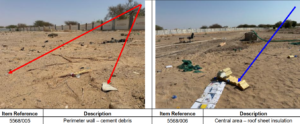
As part of a site investigation, an EAD registered and ADPHC approved asbestos specialist surveyed a former plant nursery in Al Ain before redevelopment. Several structures had already been demolished. Of 23 bulk and soil samples, 15 contained asbestos, mostly cement debris mixed into the sand, with chrysotile and amosite fibres. All were rated Category C (low risk), but they must still be removed by approved contractors before construction continues.
How CGT can help
CGT Engineering Consultant and Delma Laboratory combine asbestos surveys with soil contamination and geotechnical investigations, so one site visit covers everything you need before demolition or excavation:
- Asbestos surveys of buildings, surface debris and soil, carried out with EAD-approved specialists
- Soil contamination testing to ADS 19/2017 at the same time
- Clear reports your consultant, ADOSH and EAD can rely on
- Guidance on appointing an independent supervising consultant and removal contractor
- How much asbestos survey cost?
- Demolition and removal contractor near me
Clearing an older site? Contact us at info@cgteng.com before the first building comes down.
Sources
- Federal Cabinet Resolution No. 39 of 2006; Federal Ministerial Decision No. 42 of 2008; Federal Law No. 24 of 1999
- ADOSH Code of Practice 1.10, Management of Asbestos Containing Materials
- UK HSE HSG 264, Asbestos: The Survey Guide; HSG 248, Asbestos: The Analysts’ Guide